Why Korean Schools Have Shoe Lockers and Indoor Slippers: A Cultural Habit That Foreigners Never Expect

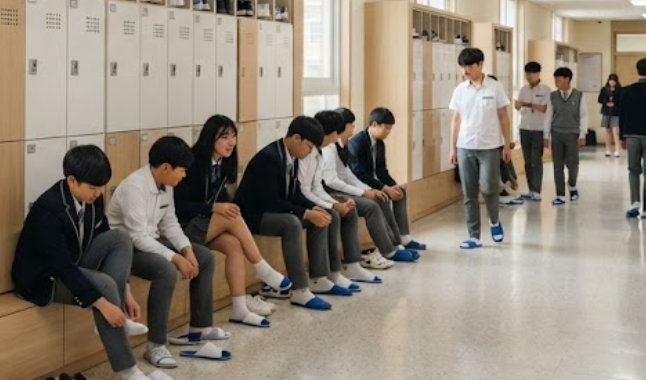
When foreigners first walk into a Korean school, they often stop at the entrance, confused.
Students are lined up in front of small wooden or metal lockers, bending down to change their shoes.
Outdoor sneakers come off, indoor slippers go on.
It’s a simple action, but for many foreigners, it’s a moment of cultural shock.
“Why are they changing shoes?”
“Is this a rule?”
“Do all schools do this?”
“Is this a hygiene thing?”
Yes, it’s a rule.
Yes, all schools do it.
And yes, it’s partly about hygiene — but the real story goes much deeper.
Korean schools have shoe lockers and indoor slippers because Korea has a unique relationship with the concept of “inside.”
To understand this tradition, you have to understand Korea’s history, architecture, psychology, and even its climate.
✦ The Tradition Begins at Home: Korea’s Floor-Based Living Culture
Korea’s indoor slipper culture doesn’t start at school.
It starts at home — centuries ago.
Traditional Korean houses were built with ondol, a floor-heating system that warms the entire room from beneath.
Because the floor was warm, clean, and central to daily life, Koreans naturally developed a lifestyle centered around the ground.
People sat on the floor, slept on the floor, ate on the floor, and lived close to the floor.
And when the floor is your living space, shoes become the enemy.
Shoes bring dirt, dust, mud, rainwater, and germs.
So Koreans removed them at the door — not as a rule, but as a cultural instinct.
This instinct followed Koreans everywhere:
homes, temples, traditional restaurants, and eventually… schools.
✦ Schools Became Extensions of Home
Korean schools were designed not as public buildings, but as “second homes.”
Teachers often say that school is “a second home” for students, a place where they spend most of their day learning, resting, and growing.
Students spend most of their day there — studying, eating, resting, socializing.
So the idea was simple:
If home is a place where shoes come off, school should be too.
This is why Korean schools have:
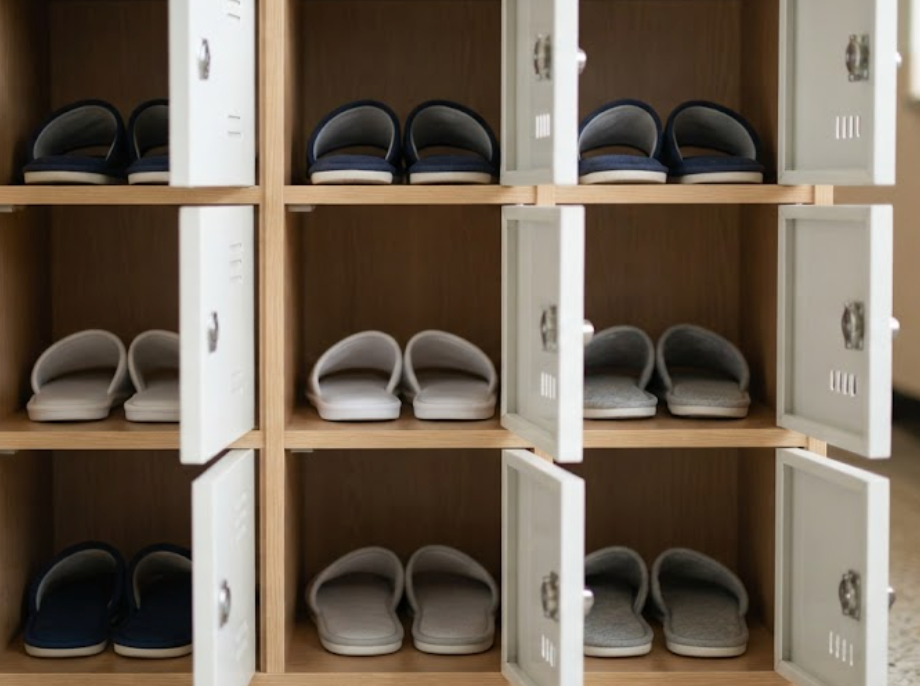
• shoe lockers at the entrance
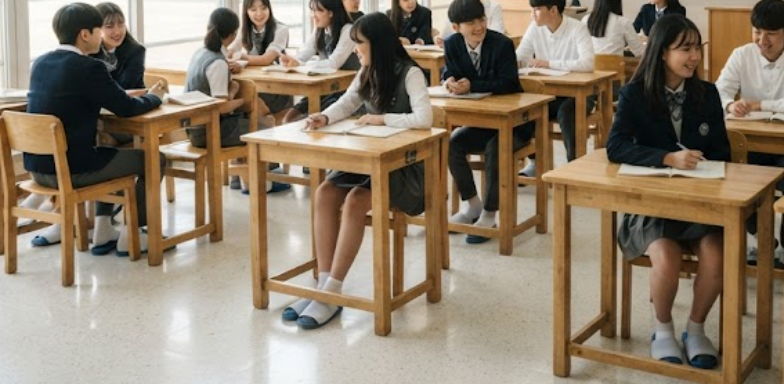
• indoor slippers for every student
• clean floors that shine even after thousands of footsteps
• quiet hallways where footsteps barely echo
Foreigners often say Korean schools feel “peaceful” or “calm.”
The indoor slipper culture is one of the biggest reasons why.
✦ Cleanliness Is Not Just a Preference — It’s a System
Korean schools are shockingly clean compared to many Western schools.
Floors are polished.
Hallways are spotless.
Classrooms smell fresh.
Trash is minimal.
This isn’t magic.
It’s the result of a cultural system.
Students clean their own classrooms.
They sweep the hallways.
They wipe desks.
They empty trash bins.
They mop floors.
If students are responsible for cleaning, it makes sense to reduce the amount of dirt entering the building.
Indoor slippers help maintain cleanliness and reduce the workload.
Foreigners often say:
“This school is cleaner than my office.”
“How is the floor this shiny?”
“Do students really clean everything?”
Yes, they do.
And indoor slippers make it possible.
✦ Safety and Noise Control: The Hidden Benefits
Indoor slippers aren’t just about cleanliness.
They’re also about safety.
Outdoor shoes have hard soles that slip easily on polished floors.
Indoor slippers are designed with soft, non-slip bottoms that grip the ground.
This reduces:
• slipping accidents
• hallway collisions
• noise from running
• echoing footsteps
Korean schools are surprisingly quiet.
You don’t hear the loud clacking of shoes on tile floors.
Instead, you hear soft shuffling — almost like a library.
Foreigners often say:
“Why is this school so quiet?”
“Where are all the loud footsteps?”
“Is everyone walking slowly?”
No — they’re just wearing slippers.
✦ School Architecture That Encourages Indoor Footwear
Korean school buildings are designed with materials that work best with indoor slippers.
Floors are often:
• polished linoleum
• smooth vinyl
• treated wood
• heated surfaces
These materials are comfortable, but they scratch easily.
Outdoor shoes damage them quickly.
Indoor slippers protect them.
Some older schools even have heated floors in certain areas, continuing the ondol tradition.
Walking on heated floors with outdoor shoes would feel strange — almost disrespectful.
✦ Cultural Psychology: The Korean Concept of “Inside”
To truly understand indoor slippers, you have to understand the Korean mindset.
Koreans have a strong mental boundary between:
• inside
• outside
Outside is dirty, chaotic, unpredictable.
Inside is clean, safe, controlled.
This boundary is so strong that Koreans instinctively remove shoes even in places where foreigners wouldn’t:
• study rooms
• daycare centers
• certain offices
• private academies
• some restaurants
• traditional cafés
Schools simply follow this cultural logic.
Foreigners often say:
“Koreans really respect indoor spaces.”
“It feels like entering a sacred place.”
“The inside/outside boundary is so clear.”
They’re right.
✦ A Quick Comparison: How Other Countries Do It
Most Western schools allow outdoor shoes inside.
Students walk in with muddy boots, wet sneakers, or dusty soles.
Floors get dirty quickly.
Noise levels are high.
Cleaning staff work constantly.
Japan has a similar indoor slipper culture, but Korea’s system is more standardized.
Taiwan has some schools with indoor slippers, but not nationwide.
Korea is one of the few countries where:
• every school has shoe lockers
• every student has indoor slippers
• the rule is universal and unquestioned
It’s not a trend — it’s a cultural foundation.
✦ Modern Indoor Slippers: A New Form of Self-Expression
Indoor slippers used to be simple white rubber shoes.
Now they’re part of student identity.
You’ll see:
• pastel-colored slippers
• cartoon characters
• sporty designs
• custom initials
• matching slippers among friends
Some schools allow freedom of choice.
Others require specific designs.
Either way, indoor slippers have become a small but meaningful part of Korean school fashion.
Foreigners often say:
“These slippers are so cute.”
“I want a pair.”
“Why don’t we have this in my country?”
✦ Foreigners’ Reactions: A Mix of Surprise and Admiration
Here are real reactions foreigners often have:
• “This is so clean. I love it.”
• “Why don’t we do this in our country?”
• “It makes so much sense.”
• “The school feels peaceful.”
• “I wish my school had this system.”
What begins as confusion often turns into admiration.
Indoor slippers aren’t just a rule — they’re a cultural philosophy.
✦ Conclusion: Indoor Slippers Are a Window Into Korean Culture
Korean schools have shoe lockers and indoor slippers because Korea values:
• cleanliness
• safety
• respect for shared spaces
• quiet environments
• floor-based living traditions
• cultural boundaries between inside and outside
Indoor slippers are not just footwear.
They are a symbol of Korean lifestyle, history, and identity.
They represent a culture that cares deeply about harmony, cleanliness, and respect.
For foreigners, this small detail becomes one of the most memorable parts of Korean school life.
For Koreans, it’s simply the way things have always been — and always will be.