
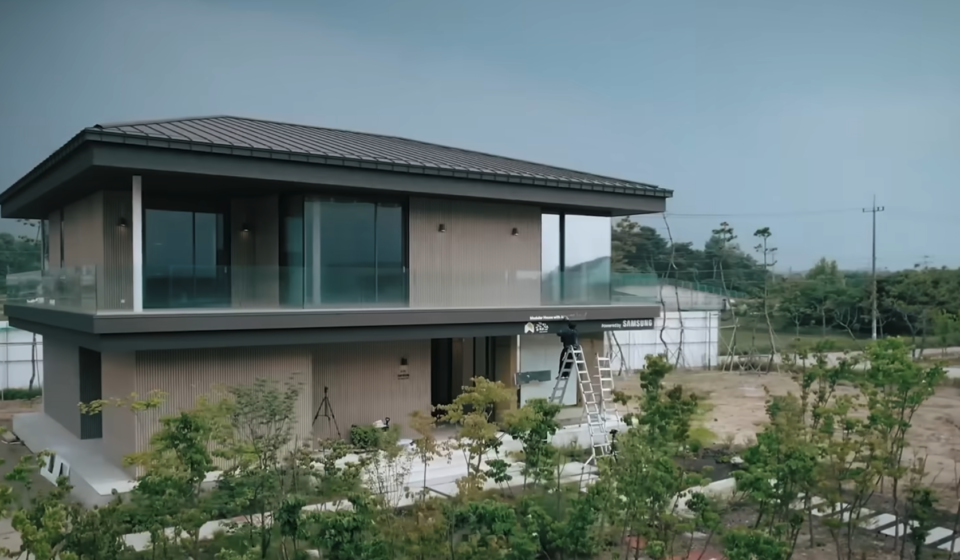

Imagine walking into a factory and seeing entire houses moving down an assembly line.
Not steel beams.
Not piles of concrete.
Actual homes.
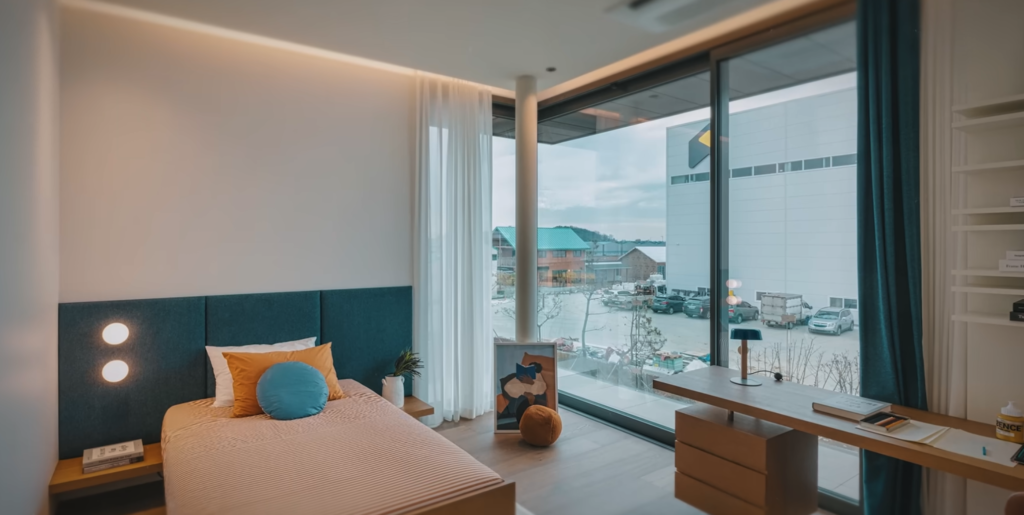
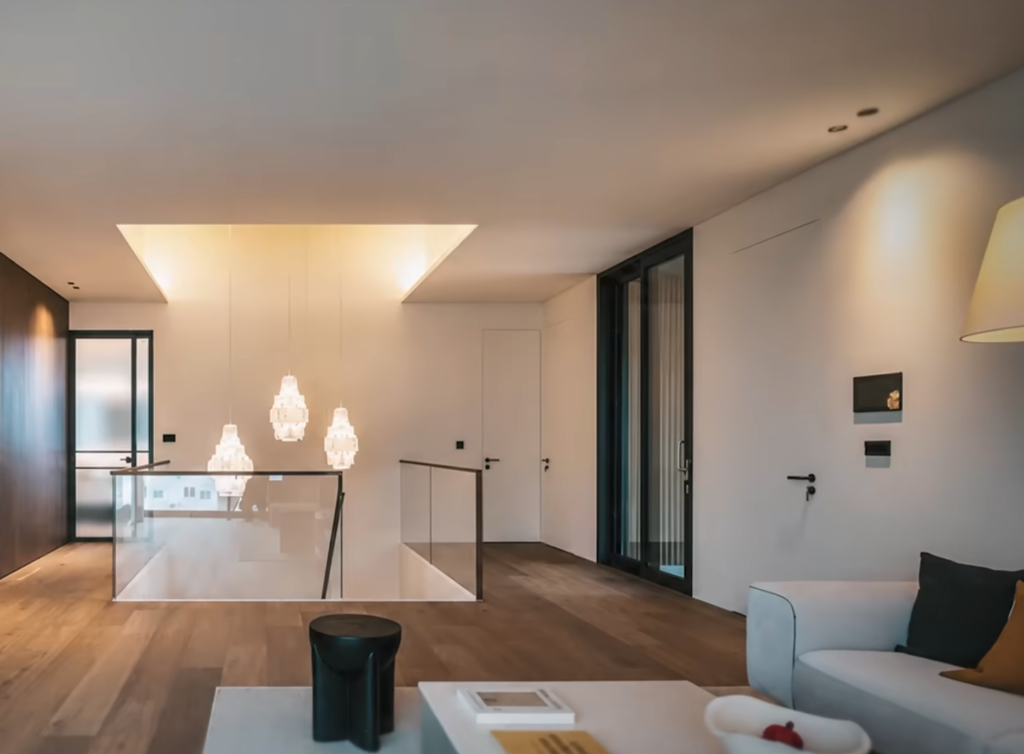
Living rooms, bedrooms, bathrooms, kitchens, electrical wiring, plumbing, lighting, and even appliances already installed.
It sounds like something from a futuristic science-fiction movie.
But it is happening right now in South Korea.
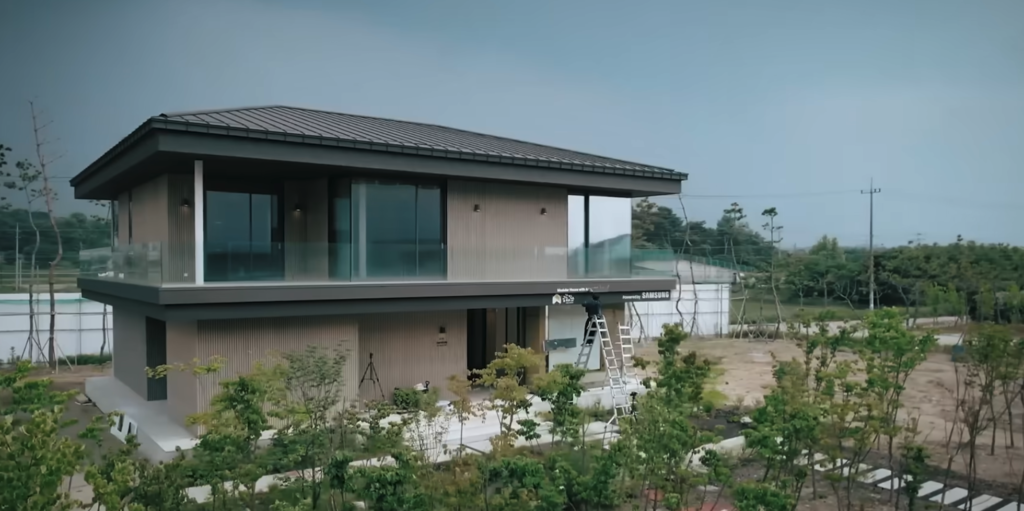
A new generation of modular homes is being manufactured in factory environments, where much of the construction process is completed before the home ever reaches its final location. Some models can be produced in as little as a week, and a fully equipped 30-pyeong home, roughly 1,070 square feet, can cost around $100,000 to $120,000 depending on configuration.
In a country where apartment prices in Seoul often reach several million dollars, the idea sounds almost unbelievable.
Yet what may be even more surprising is the company behind the movement.
The name attracting attention is not a traditional construction giant.
It is Samsung.
The same Samsung known for semiconductors, smartphones, televisions, and home appliances.
So why would a technology company suddenly become interested in housing?
At first glance, it looks like Samsung wants to sell homes.
But the deeper story reveals something far more ambitious.
Samsung may not be trying to sell houses at all.
The Problem With Building a Home the Traditional Way
For many people, building a house is one of life’s biggest dreams.
It is also one of life’s biggest headaches.
Ask anyone who has built a custom home from scratch, and chances are they will tell you the same thing.
“I would never do it again.”
The process often begins with confusion.
One builder offers a quote of $80,000.
Another quotes $150,000.
A third quotes even more.
All for what appears to be the same house.
The explanations are usually difficult for ordinary buyers to evaluate.
Different insulation.
Different windows.
Different materials.
Different construction standards.
To construction professionals, these differences are obvious.
To most homeowners, they are not.
The uncertainty does not end once construction begins.
Homeowners often worry about whether the promised materials are actually being used.
Unexpected costs frequently appear.
Additional site work.
Unexpected soil conditions.
Permit issues.
Design changes.
Material price fluctuations.
What started as one budget slowly becomes something entirely different.
This is why many people joke that building a house ages you by ten years.
The joke exists because there is some truth behind it.
Why Housing Has Been Different From Everything Else
Think about how we buy almost every expensive product.
When you purchase a car, you see the finished vehicle.
When you buy a refrigerator, you inspect the actual product.
When you purchase a smartphone, you know exactly what you are getting.
Housing is different.
We sign contracts worth hundreds of thousands or even millions of dollars based largely on blueprints, renderings, and promises.
The final product often does not exist yet.
In many ways, it is one of the only major purchases where consumers commit before seeing the completed item.
For decades, this has simply been accepted as normal.
But perhaps that normal is beginning to change.
How Modular Homes Work
The key innovation behind these factory-built homes is modular construction.
Instead of building every wall, room, and utility system on-site, entire sections of the home are constructed inside a controlled factory environment.
Think of the process like building with giant LEGO blocks.
A bedroom becomes a module.
A bathroom becomes a module.
A kitchen becomes a module.
A living room becomes a module.
Each section is manufactured separately and then transported to the construction site for final assembly.
The important detail is that these modules are not empty boxes.
When they leave the factory, many already contain:
- Finished flooring
- Wallpaper and interior finishes
- Electrical wiring
- Plumbing systems
- Lighting fixtures
- Bathroom equipment
- Kitchen installations
By the time the modules arrive on-site, much of the work is already finished.
Instead of constructing a home piece by piece, workers assemble pre-built sections into a completed structure.
Why Factory Construction Is Faster
One of the biggest challenges in traditional construction is the weather.
Rain delays projects.
Snow creates problems.
Extreme heat affects workers.
Cold temperatures can slow concrete curing.
An entire schedule can fall behind because of environmental conditions.
Factories eliminate these issues.
Production takes place indoors under controlled temperatures and humidity.
Work continues regardless of season.
January looks the same as July from a manufacturing perspective.
There is another major advantage.
Traditional construction relies on multiple trades working in sequence.
Electricians wait for carpenters.
Plumbers wait for electricians.
Interior crews wait for structural work to finish.
Delays create more delays.
Factories operate differently.
Each team performs specialized tasks as part of an ongoing production line.
The process becomes more predictable and efficient.
The result is shorter construction times and lower labor costs.
Building Houses Like Cars
Perhaps the most fascinating part of modular housing is what many visitors notice inside the factories.
The equipment looks more like an automobile manufacturing plant than a construction site.
Robotic systems assemble walls.
Automated equipment performs repetitive precision tasks.
Advanced production methods borrowed from the automotive industry are being applied to residential construction.
This may be the real revolution.
For decades, housing remained one of the last major industries that had not fully embraced manufacturing principles.
Cars became standardized.
Electronics became standardized.
Appliances became standardized.
Housing largely did not.
Now the same philosophy that transformed automobile production is beginning to enter home construction.
The idea is simple.
If factories can consistently produce millions of reliable cars, why shouldn’t they produce homes with the same level of consistency?
Can You Really Buy a House for $100,000?
This is where things become more complicated.
The headline numbers sound incredibly attractive.
However, buyers must understand what those numbers actually include.
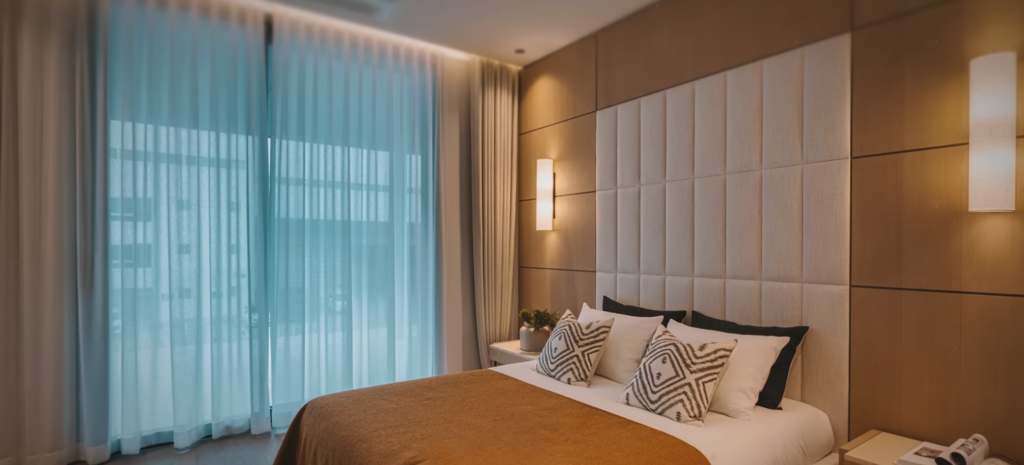
The advertised price typically covers the modular structure itself.
Additional costs still exist.
These often include:
- Site preparation
- Concrete foundations
- Transportation
- Crane installation
- Design fees
- Permits
- Utility connections
Industry professionals often estimate that total project costs can increase by 20 to 40 percent beyond the advertised structure price.
That means buyers should look beyond the headline figure before making comparisons.
Even so, modular construction frequently remains more affordable than many traditional building methods.
The Hidden Benefit Isn’t Price
Interestingly, many people who visit modular housing showrooms focus on something other than cost.
They talk about predictability.
A clearly defined product.
A fixed price.
A known construction timeline.
Standardized quality.
These benefits appeal to homeowners who have experienced the uncertainty of traditional construction.
In other words, many buyers are not simply looking for a cheaper house.
They are looking for a less stressful process.
That may be just as valuable.
Samsung’s Real Goal Is Not Selling Houses
This is where the story takes an unexpected turn.
Samsung is not primarily the company manufacturing these homes.
Specialized modular housing firms handle most of the construction.
So what exactly is Samsung doing?
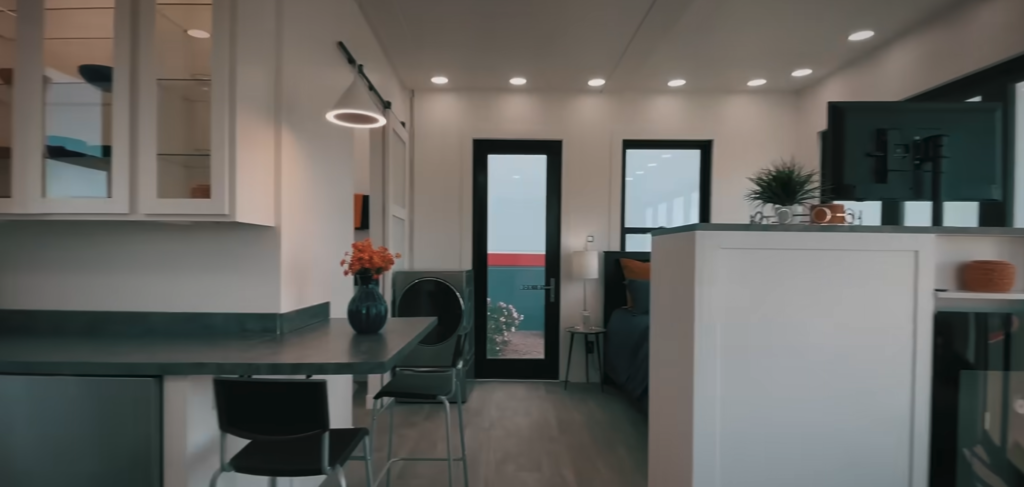
Samsung is focusing on everything inside the home.
That distinction matters.
Very few people buy a house every few years.
But once someone moves into a connected ecosystem, they may stay for decades.
Samsung’s strategy centers on integrating SmartThings and artificial intelligence into the home from the beginning.
Rather than adding smart devices after construction, connectivity becomes part of the home’s core design.
The house is already prepared for Samsung appliances.
Samsung sensors.
Samsung automation.
Samsung AI services.
Samsung security systems.
Everything is connected from day one.
Samsung Wants Homes Designed for AI
Traditional smart homes often require homeowners to build their own ecosystem.
They purchase devices one at a time.
Install apps.
Connect products.
Configure networks.
Troubleshoot compatibility issues.
Factory-integrated smart housing changes that sequence entirely.
The technology is embedded during construction.
By the time residents move in, the ecosystem already exists.
The home functions more like a giant connected device than a collection of separate products.
This may explain why Samsung is interested.
The company is not simply selling a house.
It is creating an environment where Samsung services and artificial intelligence become part of everyday life.
A Home That Watches Over You
The future vision extends beyond convenience.
AI-powered homes are expected to handle security, energy management, and safety automatically.
If a window opens unexpectedly, the owner receives an alert.
If smoke is detected, notifications can be sent to family members as well as residents.
Lighting and climate systems can adjust according to daily routines.
Robot vacuums may double as mobile security monitors.
Energy consumption may be optimized automatically.
The house gradually becomes more responsive to its occupants.
Supporters describe this as intelligent living.
Critics raise questions about privacy.
Both perspectives deserve consideration.
The Biggest Limitation: Land Still Costs Money
One misconception should be avoided.
Modular housing is not a magical solution to housing affordability.
The structure itself is only part of the equation.
In many cities, especially Seoul, the largest portion of housing costs comes from land.
Reducing construction expenses does not make expensive land cheaper.
This means factory-built housing is unlikely to solve urban housing shortages on its own.
However, it could be highly attractive in other situations.
Inherited rural land.
Retirement homes.
Vacation properties.
Public housing projects.
Affordable housing developments.
These areas may benefit significantly from faster, lower-cost construction methods.
Could Housing Follow the Same Path as Clothing?
There is an interesting historical comparison.
Before mass production, clothing was often custom-made.
People visited tailors.
Measurements were taken.
Each garment was created individually.
When ready-made clothing appeared, many people viewed it as inferior.
Today, mass-produced clothing dominates the market.
Custom tailoring still exists, but it occupies a premium position.
Housing may follow a similar path.
Custom-built homes will likely continue to exist.
But factory-built homes could become increasingly common for mainstream buyers.
What once seemed unusual may eventually feel completely normal.
Conclusion
At first glance, the story appears to be about inexpensive factory-built houses.
In reality, it is about something much larger.
The construction industry is beginning to adopt manufacturing principles that transformed sectors such as automobiles and electronics.
At the same time, companies like Samsung are positioning themselves not merely as appliance makers but as architects of entire living ecosystems.
The most important product may not be the house at all.
It may be the network, software, sensors, and artificial intelligence embedded inside the walls.
For previous generations, the dream was simply owning a house.
For future generations, the definition of a home may be very different.
A home may no longer be a structure that passively shelters its residents.
Instead, it may become an intelligent system that protects, assists, learns, and communicates.
And if that future arrives, Samsung will not just be selling houses.
It will be selling the operating system of everyday life.