

Telemedicine in Korea 2026: What the New Law Means for Online Doctor Visits, Prescriptions and Digital Health

During the COVID-19 pandemic, many people in Korea saw a doctor through a phone or video call for the first time. What started as a temporary emergency measure is now becoming a permanent part of the healthcare system. In December 2025, Korea’s National Assembly passed an amendment to the Medical Service Act that formally allows telemedicine (called bidaemyeon jillyo, “non-face-to-face care,” in Korean), ending a debate that had lasted about 15 years.
If you live in Korea, work here, or are planning a long stay, this change will affect how you can see a doctor, get a prescription, and use health apps. Here is a clear guide to what the new rules mean, who can use telemedicine, and how digital health and medical AI are changing care in Korea.
Key points at a glance
- Telemedicine in Korea is now written into law, but in-person care remains the rule. Remote visits are a supplement, not a replacement.
- It is mainly for patients who have already seen the same clinic in person for the same condition.
- First-time remote visits are allowed only under limits, such as using a clinic in your own area and restrictions on what can be prescribed.
- Drugs with a risk of misuse, such as narcotics, cannot be prescribed remotely.
- The law takes effect about one year after it was promulgated, so full implementation is expected around the end of 2026. Until then, the government’s pilot program continues.
From Pandemic Exception to Official System

Remote medical care was technically restricted in Korea for decades. The pandemic changed that: in 2020, the government temporarily allowed phone and video consultations so patients could get care without visiting crowded hospitals. Millions of consultations later, the temporary measure became a government pilot program in 2023.
The pilot showed both the benefits and the risks. It helped people who had trouble reaching a clinic, but it also raised concerns about safety, prescription misuse, and who is responsible when something goes wrong. The new law tries to balance these issues with one guiding idea: expand access, but keep it safe.
Who Can Use Telemedicine Under the New Rules?
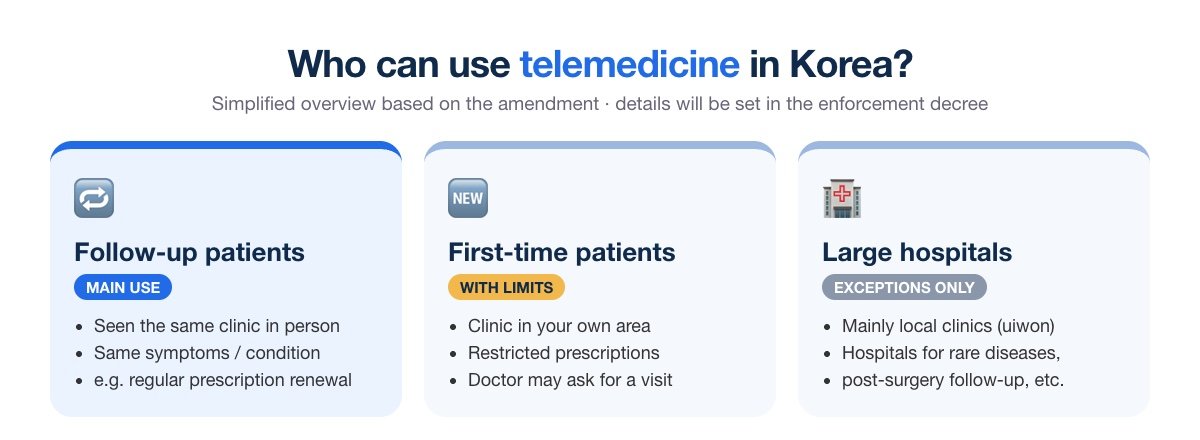
Follow-up patients: the main group
The system is designed mainly for patients who have recently had an in-person visit at the same clinic for the same symptoms. For example, if you see a local doctor for high blood pressure, follow-up consultations to check your condition or renew a regular prescription may be done remotely.
First-time patients: allowed, with limits
If you have never visited the clinic before, telemedicine is still possible in some cases, but with restrictions. According to reports on the amendment, first visits are generally limited to medical institutions in the area where the patient lives, and the range of prescriptions is restricted.
Mainly local clinics, not large hospitals
Telemedicine will mainly be provided by smaller clinics (uiwon). Larger hospitals are expected to offer it only in special cases, such as patients with rare diseases or people who need follow-up after surgery. Detailed rules will be finalized in the enforcement decrees before the law takes effect.
Prescriptions and Medicine Delivery
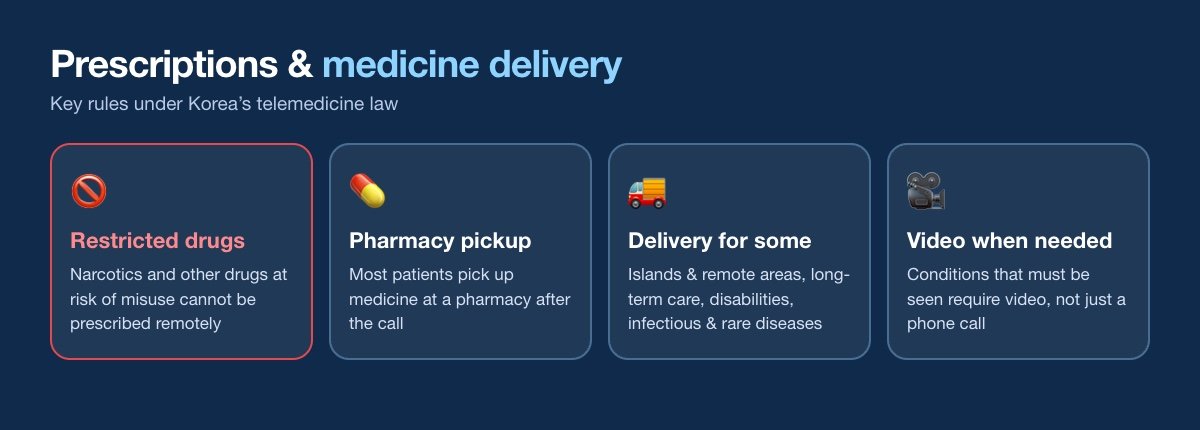
- Restricted drugs: medicines with a high risk of misuse or abuse, such as narcotics, cannot be prescribed through telemedicine.
- Pharmacy pickup is the norm: after a remote consultation, most patients will still pick up their medicine at a pharmacy.
- Delivery only for certain groups: home delivery of medicine is allowed for limited groups, including people living on islands or in remote areas, long-term care recipients, registered persons with disabilities, patients with confirmed infectious diseases, and patients with rare diseases.
- Video when needed: for conditions where a doctor needs to see the patient, video consultation rather than a simple phone call is expected to be required.
Who Is Responsible? Safety and Consent
One of the biggest questions during the debate was responsibility. Under the new law, doctors must explain the limits and characteristics of telemedicine to patients and get their consent, and the scope of a doctor’s legal responsibility is spelled out. If a doctor decides that a condition cannot be handled safely online, they can ask the patient to come in for an in-person visit.
For patients, this means you should be ready to describe your symptoms clearly, share your medical history and current medicines, and follow the doctor’s advice if an in-person visit is recommended.
Digital Health and Medical AI: Korea’s Next Step
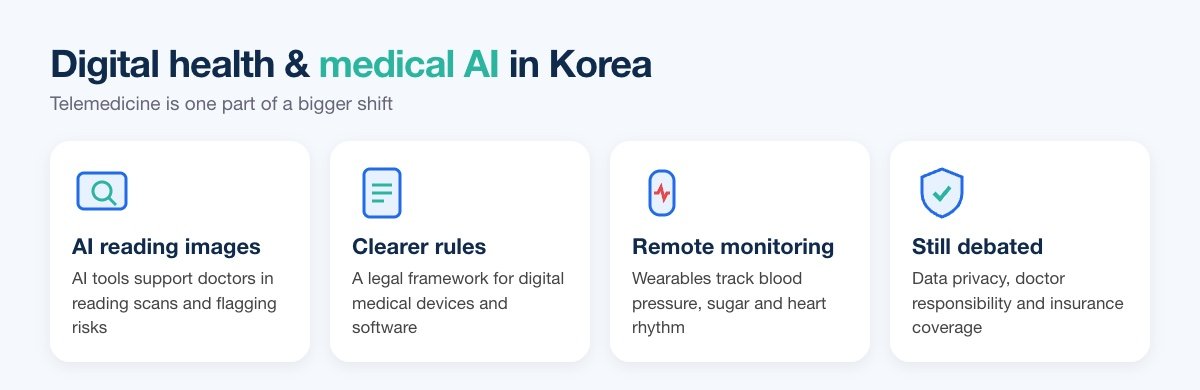
Telemedicine is only one part of a bigger shift toward digital health in Korea. Korea already has fast internet, widely used health apps, and a national health insurance system with digital records, which makes it a natural testing ground for new technology.
- Medical AI in real clinics: AI tools that help read medical images or support diagnosis are receiving approval as clinical evidence builds up, and more hospitals are using them in everyday care.
- Clearer rules for digital medical products: Korea has introduced a dedicated legal framework for digital medical devices and software, so new products can be evaluated in a more predictable way.
- Remote monitoring: wearable devices and apps that track blood pressure, blood sugar, or heart rhythm are increasingly connected to care, especially for older adults and people with chronic diseases.
At the same time, important questions remain: how to protect patient data, how to make sure doctors stay in charge of medical decisions, and how AI-based care should be covered by health insurance.
Why It Matters: Access to Care
Korea is also working to strengthen regional and essential healthcare and to reduce long trips and waiting times for patients. Telemedicine and digital tools are expected to help especially:
- older adults and people with limited mobility,
- people living on islands or in rural areas far from hospitals,
- patients with chronic conditions who need regular check-ins,
- busy workers who find it hard to visit a clinic during the day.
Tips for Foreigners Living in Korea
- Check your health insurance: most telemedicine services are connected to Korea’s National Health Insurance. If you are enrolled, your costs are generally the same as for a regular clinic visit.
- Keep a regular clinic: since follow-up care is the main use, having a local clinic you have already visited in person makes telemedicine much easier.
- Prepare for identity checks: many telemedicine apps ask for identity verification with a Korean phone number or your Alien Registration Card (residence card). Check what each app requires.
- Ask about language support: some clinics and apps offer English or other languages, but not all. Ask in advance if you need help.
- Know when to go in person: chest pain, breathing problems, serious injuries, or sudden severe symptoms need emergency or in-person care. Call 119 in an emergency.
Частые вопросы
Is telemedicine legal in Korea now?
Yes. The amendment to the Medical Service Act passed the National Assembly in December 2025 and makes telemedicine part of the official healthcare system. It takes effect about one year after promulgation, expected around the end of 2026. Until then, telemedicine continues under the government’s pilot program.
Can I see a new doctor online for the first time?
In limited cases. First-time remote visits are generally restricted to clinics in your own area, and some prescriptions are not allowed. Follow-up visits with a clinic you have already visited in person are the main use of telemedicine.
Can I get medicine delivered to my home?
Only certain groups, such as people on islands or in remote areas, long-term care recipients, registered persons with disabilities, patients with infectious diseases, and patients with rare diseases. Most patients will pick up their medicine at a pharmacy.
Can foreigners use telemedicine in Korea?
Foreign residents enrolled in National Health Insurance can generally use the same services as Korean citizens. Requirements can differ by app and clinic, especially for identity verification, so check before you book.
Will AI replace doctors in Korea?
No. Medical AI is being used to support doctors, for example in reading images or flagging risks, but the final medical decision stays with a licensed doctor.
Итоги
Korea’s approach to telemedicine and digital health can be summed up in one phrase: expand, but safely. Online consultations are becoming an official option, medical AI is moving into real clinics, and new rules are being written to protect patients. For people living in Korea, this means more convenient care, especially for routine follow-ups. The detailed rules are still being finalized before the end of 2026, so keep an eye on official announcements and ask your clinic how they plan to offer remote care.
Sources: Korea.kr policy news (Ministry of Health and Welfare, Dec 2025), reports on the Medical Service Act amendment by Medifonews, K-Health and Electronic Times. This article provides general information and is not medical or legal advice. Detailed rules may change in the enforcement decree.
Больше на aboutkorea8282.com
Подпишитесь, чтобы получать последние записи по электронной почте.